Join our free newsletter to get the latest updates from us.
[Info] The MGM Question
3/4/2026
At TestMyKratom, our goal has always been radical transparency. As the industry moves from natural leaf toward concentrated alkaloids, we are seeing a trend that puts the community at a crossroads: the rise of MGM-15 and MGM-16.
These are lab-engineered semi-synthetic analogues, not natural kratom alkaloids. While innovation is part of any maturing market, the current practice of “spiking” 7-hydroxymitragynine (7-OH) products with hidden MGM is a deceptive trend that threatens consumer trust and the industry’s legal standing.
The Pharmacology: MGM-15 vs. MGM-16
While they share a similar name, their impact on the human body—specifically the respiratory system—is vastly different.
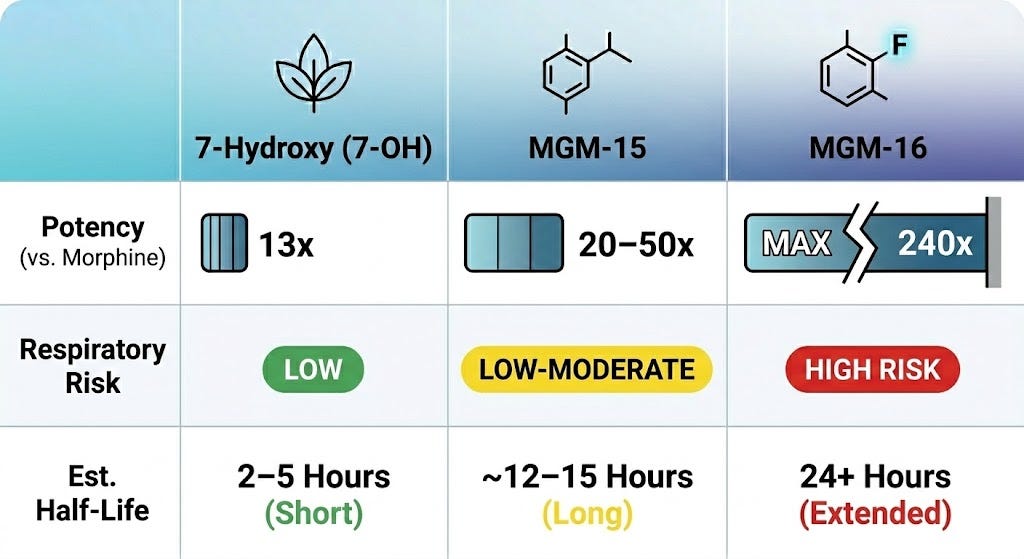
MGM-15 (The Unknown Analog): Structurally, MGM-15 is the 1,2-dihydro derivative of 7-OH. On paper, it appears to share a similar safety profile to 7-OH, but we must be clear: we lack human clinical data. While it may not trigger immediate respiratory distress at standard doses, its long-term impact on the brain is currently a “black box.”
MGM-16 (The Full Agonist): This is the high-risk outlier. Due to a specific fluorine modification, MGM-16 acts as a full μ-opioid agonist. Unlike natural kratom alkaloids, which have a “ceiling effect” on breathing, MGM-16 can interfere directly with the respiratory system. In animal studies, it tested at 240 times the potency of morphine.
The Potential Benefit: A Path to Lower Costs?
To be fair to the industry, if the safety profile of MGM-15 eventually checks out, there is a potential benefit for the consumer: Affordability.
Because MGM-15 is significantly more potent than 7-OH, a manufacturer can produce a tablet with the same level of relief for a much lower cost of goods. In a perfect world, these savings would be passed down to the consumer, making effective pain management more accessible. However, history shows that brands often pocket the margins rather than lowering prices. Without transparent labeling, the consumer never even knows they are paying 7-OH prices for a cheaper synthetic alternative.
The “Staircase Effect”: Metabolic Stacking and Tolerance
The most significant risk with MGM-15 isn’t just its potency; it is the Elimination Half-Life. While natural 7-OH leaves the system relatively quickly (approx. 2–5 hours), MGM-15 is far more “metabolically stable,” staying in the body for an estimated 12–15 hours.
This leads to what we call Metabolic Stacking. If a user doses every 6 hours, the MGM-15 from the first dose hasn’t even reached its half-life before the next dose is added.
Rapid Tolerance Build-up: Your opioid receptors are hammered 24/7 with no “rest” periods. This results in a much faster “destruction” of your tolerance than traditional 7-OH.
The Vicious Cycle: As tolerance skyrockets, users spend more money to maintain the same effect. If the withdrawal process for MGM-15 proves to be more intense or “vicious” than 7-OH, it provides the perfect argument for regulators to justify a total federal ban.
Comparison Table: The Triple Threat
The Bottom Line
The 2026 regulatory landscape is unforgiving. Spiking products with unlabeled synthetics that cause rapid addiction or respiratory risk is exactly what invites federal intervention. At Test My Kratom, we believe in a simple rule: If it’s in your tab, it MUST be on the label.
© 2026 TestMyKratom | Terms | Grading System